
Canada has changed how public companies can make certain financial disclosure available to investors.
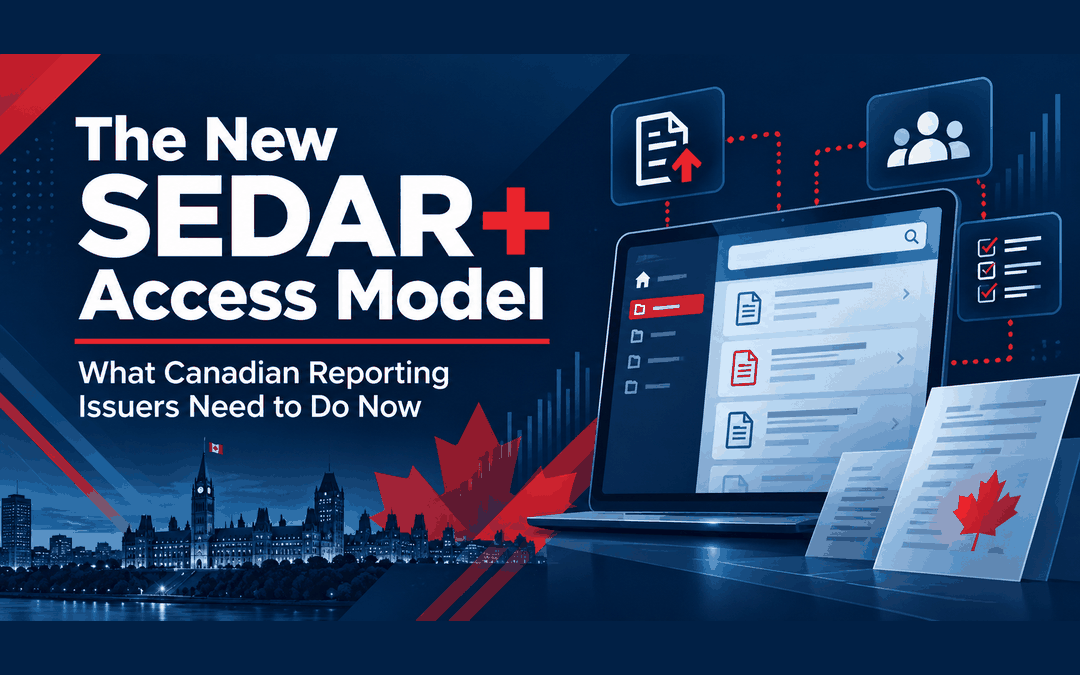
Effective September 22, 2026, the Canadian Securities Administrators’ new Access Model allows non-investment fund reporting issuers to use electronic access for annual financial statements, interim financial reports and the related management’s discussion and analysis instead of following the traditional securities-law delivery process, provided the prescribed conditions are met.
The model is voluntary. It does not change the requirement to file the applicable continuous disclosure documents on SEDAR+. It changes how an issuer may satisfy certain delivery obligations after those documents are filed.
For reporting issuers considering the new model, the important point is that this is not simply a decision to stop mailing financial statements. The Access Model creates a specific disclosure and communications process with deadlines that need to be built into the issuer’s reporting calendar.
What the New Access Model Covers
The Access Model applies to reporting issuers other than investment funds and covers:
- annual financial statements;
- interim financial reports;
- annual MD&A; and
- interim MD&A.
An issuer can decide whether the model is appropriate for its circumstances. It can also continue using existing delivery methods.
The new regime is designed around electronic access through SEDAR+, supported by issuer news releases, website access where applicable and the ability of investors to continue requesting paper or electronic copies.
1. Decide Whether the Access Model Fits the Issuer
The first decision is whether using the Access Model actually makes sense for the company and its shareholder base.
For some issuers, reducing routine printing and mailing can lower costs and simplify administration. For others, the existing delivery process may remain appropriate because of shareholder preferences, corporate-law requirements or other practical considerations.
Management should make the decision with the issuer’s securities counsel, transfer agent and other service providers early enough to implement the required notice and delivery procedures.
Issuers should also determine whether they intend to use the model for annual financial statements and MD&A, interim financial reports and MD&A, or both. If the Access Model is not used for a category of documents, the existing delivery requirements continue to apply to that category.
2. Give Investors at Least 25 Calendar Days’ Advance Notice Before First Use
An issuer cannot simply use the new model at its next reporting deadline without advance preparation.
Before first relying on the Access Model, the issuer must issue and file a news release on SEDAR+ at least 25 calendar days before it first uses the model.
The advance disclosure must tell investors that the applicable financial statements and MD&A will be accessible electronically and explain:
- how the documents can be accessed electronically;
- that SEDAR+ notification functionality is available;
- how an investor can request an electronic or paper copy; and
- that existing standing instructions to receive the documents electronically or in paper form will continue to be followed.
This 25-day requirement means the decision should be incorporated into the issuer’s financial-reporting calendar well before the filing date.
3. File the Continuous Disclosure Documents on SEDAR+
The Access Model does not replace the issuer’s SEDAR+ filing obligations.
The annual or interim financial statements and related MD&A must still be filed on SEDAR+ in accordance with the applicable securities-law requirements.
The Access Model operates on top of that filing. The SEDAR+ filing becomes the foundation for providing electronic access to investors.
4. Issue and File the Required News Release Within One Calendar Day
After filing the applicable documents on SEDAR+, an issuer relying on the Access Model must issue and file a news release on SEDAR+ not more than one calendar day after the filing.
The news release must inform investors that:
- the documents are accessible electronically;
- SEDAR+ notification functionality is available;
- an electronic or paper copy can be obtained upon request; and
- standing instructions for electronic or paper delivery will continue to be followed.
The timing is important. The rule uses calendar days, not business days. Issuers and their filing agents should therefore build the news-release requirement into the same operational workflow as the financial-statement and MD&A filing.
The required disclosure may be incorporated into another appropriate news release, such as an earnings release, provided the prescribed information is included.
5. Update the Company Website Within Two Calendar Days
If the issuer maintains a website, it must make the documents accessible there not more than two calendar days after the SEDAR+ filing.
The issuer can post the documents themselves or provide a hyperlink that leads directly to the documents filed on SEDAR+.
This creates another process that should be coordinated with the company’s disclosure team. Responsibility should be assigned in advance so the website update does not become an afterthought after the SEDAR+ filing is completed.
6. Update Annual Proxy-Related Communications
Using the Access Model also creates an annual communication requirement.
The issuer must provide investors with the prescribed information about electronic access, SEDAR+ notifications, obtaining copies and standing instructions through its annual proxy-related materials, its notice under the notice-and-access regime, or a separate document sent with those materials.
If the issuer maintains a website, the required information must also be available in the same location where the continuous disclosure documents, or direct links to those documents, are posted.
Issuers planning to use the Access Model should therefore update their annual meeting and proxy-material preparation checklist rather than treating the change solely as a finance-department issue.
7. Continue Honouring Investor Requests and Standing Instructions
The Access Model does not eliminate an investor’s ability to receive financial disclosure directly.
Investors can continue to request electronic or paper copies of the applicable documents. Existing standing instructions for delivery must also continue to be followed.
That means issuers still need a reliable process for receiving, tracking and fulfilling document requests even if routine delivery is reduced.
Electronic access should be viewed as an alternative delivery framework, not as the elimination of investor delivery rights.
8. Confirm Other Delivery Requirements Before Changing the Process
The new Access Model addresses securities-law delivery requirements. Reporting issuers should also confirm whether separate obligations under applicable corporate statutes, constating documents or other legal requirements continue to require delivery of financial statements or related materials.
This is particularly important for issuers incorporated under corporate statutes that impose their own shareholder communication requirements.
The practical implementation decision should therefore be coordinated with securities counsel rather than made solely as an administrative cost-saving measure.
What Reporting Issuers Should Do Now
For companies considering the Access Model, the immediate implementation checklist is straightforward:
- Decide scope: annual documents, interim documents or both.
- Work backward from the filing date: schedule the required first-use news release at least 25 calendar days in advance.
- Prepare standard disclosure language: build the required Access Model information into the issuer’s news-release templates.
- Coordinate SEDAR+ and news-release timing: make sure the post-filing release can be issued and filed within one calendar day.
- Assign website responsibility: ensure the documents or direct SEDAR+ links are posted within two calendar days.
- Update annual proxy materials: incorporate the required investor information into the next annual meeting cycle.
- Maintain request procedures: continue handling electronic and paper copy requests and standing instructions.
- Confirm other legal requirements: review corporate-law and other delivery obligations before changing the issuer’s existing process.
Why This Matters Beyond Administrative Cost Savings
The Access Model is another example of Canadian securities regulation moving toward digital-first disclosure.
For companies already public, the immediate benefit may be lower printing and mailing requirements and a more streamlined investor-communications process.
For private companies considering an IPO, reverse takeover, CPC Qualifying Transaction or other Canadian going-public strategy, the change is also relevant because ongoing reporting and shareholder-communication costs are part of the economics of operating as a public company.
The new model does not eliminate those responsibilities. It changes the infrastructure used to satisfy them.
That distinction matters when management is evaluating the ongoing cost, systems and governance required after a listing is completed.
Bottom Line
The SEDAR+ Access Model is now in force and gives eligible Canadian reporting issuers a new voluntary alternative for making annual and interim financial statements and related MD&A available to investors.
But it is not automatic and it is not simply “paperless delivery.” An issuer using the model needs to plan for the 25-day first-use notice, the one-calendar-day news-release requirement, the two-calendar-day website requirement, annual investor disclosure and continued fulfilment of document requests and standing instructions.
Companies considering the change should put the process in place before the next applicable filing deadline and coordinate implementation with securities counsel, their transfer agent, filing agent and internal disclosure team.
Go Public in Canada works with private and public companies on Canadian listing, financing and capital-markets strategy. If your company is evaluating a Canadian going-public transaction or reviewing its post-listing capital-markets strategy, contact us to discuss the practical considerations.
Sources:
Canadian Securities Administrators – Access Model for certain continuous disclosure documents of reporting issuers other than investment funds
Canadian Securities Administrators – Final Access Model announcement, June 25, 2026
Ontario Gazette – Amendments to Implement an Access Model for Certain Continuous Disclosure Documents of Non-investment Fund Reporting Issuers
This article is general information only and is not legal advice. Reporting issuers should obtain advice from qualified securities counsel regarding their specific obligations.