

Special Purpose Acquisition Corporations – SPACs
- Home
- Special Purpose Acquisition Corporations – SPACs
Special Purpose Acquisition Corporations (SPACs) in Canada
A Special Purpose Acquisition Corporation (SPAC) is a company established by sponsors or founders to raise capital through an Initial Public Offering (IPO) and subsequently acquire an operating business or assets. Before completing an acquisition, the SPAC generally has no operating business of its own.
A SPAC can provide an alternative route to the Canadian public markets for an established private business. However, the structure involves specific exchange requirements, financial commitments, acquisition conditions and shareholder protections that must be considered before proceeding.
SPACs Listed in Canada
The Toronto Stock Exchange (TSX) and CBOE Canada have established SPAC listing frameworks. Each exchange has its own requirements governing the initial offering, sponsors, escrow arrangements and completion of the business acquisition.
Toronto Stock Exchange (TSX)
Under the TSX SPAC program, the minimum IPO raise is C$30 million. At least 90% of the funds raised must be placed in escrow, and the SPAC must complete a Qualifying Acquisition within 36 months of listing.
CBOE Canada
CBOE Canada, formerly known as the NEO Exchange, also has a SPAC listing framework. Its requirements include an expected market value of public float of at least C$30 million and additional provisions under section 10.16 of the CBOE Canada Listing Manual.
The appropriate exchange depends on the proposed SPAC structure, sponsors, financing arrangements and intended acquisition strategy.
SPAC Initial Public Offerings
A SPAC raises its initial capital through a prospectus offering. The proposed structure must address management and board composition, sponsor investment, the securities offered, escrow arrangements and the applicable exchange’s listing requirements.
Registered investment dealers, securities counsel, auditors and other professionals play important roles in preparing and completing the offering.
The transaction should be structured with the eventual acquisition in mind, including the capital expected to remain available after redemptions and the financial requirements of the resulting public company.
Acquisitions and Qualifying Transactions
The TSX refers to the acquisition of an operating business or assets by a SPAC as a Qualifying Acquisition. CBOE Canada uses the term Qualifying Transaction.
Although the terminology differs, both frameworks establish requirements governing the acquisition process, disclosure, shareholder protections and the resulting public company.
Depending on the exchange and transaction structure, these may include a prospectus, audited financial statements, shareholder approval, redemption rights and minimum transaction-value requirements.
For a private company considering a transaction with an existing SPAC, the assessment should address valuation, ownership dilution, available cash after redemptions, additional financing requirements, listing eligibility and the remaining transaction timetable.
A SPAC transaction should be evaluated against other going-public alternatives, including an IPO or reverse takeover, rather than assuming that the SPAC structure is automatically the most suitable route.
SPAC Structure
Establishing a SPAC requires coordination among several participants.
SPAC Sponsor
The sponsor or founding group establishes the SPAC and provides the initial leadership and resources needed to prepare the public offering.
The sponsor’s responsibilities can include assembling the board and management team, developing the proposed acquisition strategy, engaging professional advisers and helping identify suitable acquisition opportunities.
Sponsor investments, founder securities, ownership restrictions and other arrangements must comply with the applicable exchange requirements and be disclosed appropriately.
Investment Dealer
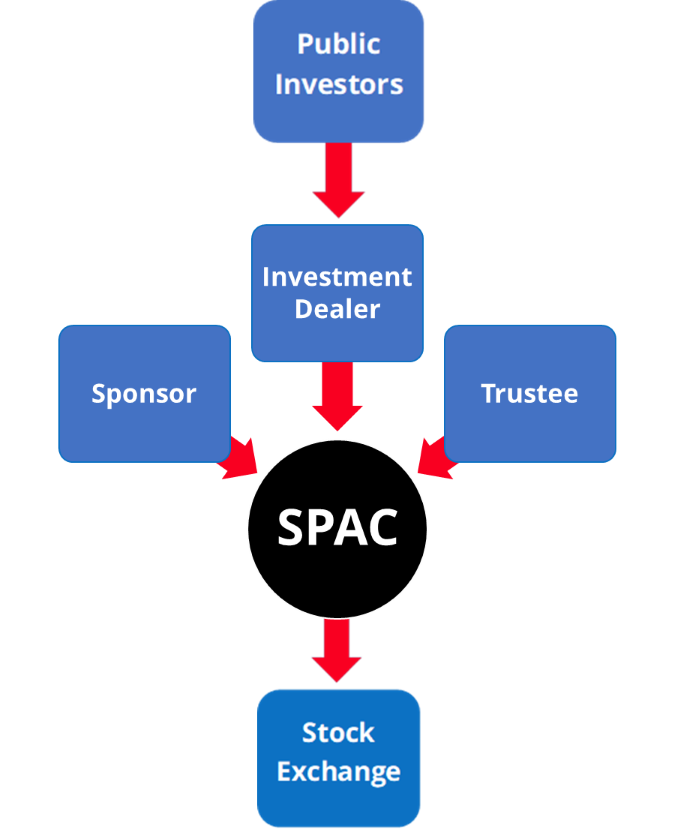 Registered investment dealers assist with the capital-raising and securities-distribution aspects of the SPAC IPO, including underwriting where applicable.
The financing structure, offering terms and investor distribution need to be coordinated with the relevant exchange requirements and the SPAC’s intended acquisition strategy.
Trustee and Escrow Arrangements
A substantial portion of the IPO proceeds must be held in escrow in accordance with applicable exchange requirements.
The escrow arrangements help govern how funds may be invested, released to complete an acquisition, returned to eligible shareholders exercising redemption rights or distributed if an acquisition is not completed within the permitted period.
The specific arrangements depend on the exchange, prospectus and applicable requirements.
Considering a SPAC Transaction?
For SPAC Sponsors and Founders
GoPublicInCanada.com can assist with assessing the proposed structure, evaluating Canadian exchange requirements, developing the transaction plan and coordinating the legal, audit, financing and exchange workstreams with the appropriate professionals.
For Private Companies Considering an Existing SPAC
We can help management assess whether a SPAC transaction fits the company’s capital requirements, valuation expectations, ownership objectives and broader going-public strategy.
This includes evaluating the proposed transaction structure, financing and dilution considerations, regulatory requirements and the work needed to complete the acquisition and resulting listing.
Whether you are considering establishing a SPAC or evaluating a transaction with an existing SPAC, contact GoPublicInCanada.com to discuss the available options and determine the next practical steps.